Wednesday, October 17, 2012

Integrating voices


Many Latin American artists and authors have dedicated their works in unifying the Latin American people and talk of just one culture. We know that this culture is not unique; moreover, it is composed of a diverse spectrum of traditions, customs and histories.  This may be the reason why the Mexican murals don’t really mean anything to me and perhaps why, in the same way, Chilean art does not mean anything to them either. Why, then, do these artist strive so much to unite cultures that are so clearly different?


Nicolás Guillen through his work Sensemaya, and his other works reveal the influence of African Americans in Cuba with the intent to integrate it in the origins of the Hispanic American culture.  Pablo Neruda also attempts to be the spokesman for those who were victims in the history of the destruction of the Incan Empire through his work Las Alturas de Machu Picchu.  In both examples we find the authors trying to incorporate voices that help us to better understand where the Latin American identity comes from, uniting them through the various races which they are composed of.


Despite the efforts of these diverse artists, how many Latin Americans actually feel pride in their African or Incan roots?  The culture is so diverse that sometimes I have to ask myself in what Latin America I lived in that I do not know the one that is interpreted by the works of some artists and authors.
Perhaps the idea of unifying Latin America as only one culture through art isn’t more than just a political manifestation.  I don’t think that it is a coincidence that these artists who unite and create this idea of one Latin American culture also shared the same political socialistic ideals.  Guillen belonged to a communist party in Cuba, as did Neruda in Chile.
 So…what is Latin America?


Even today art tries to answer that question.


Wednesday, October 10, 2012

Instruments in unifying the masses.


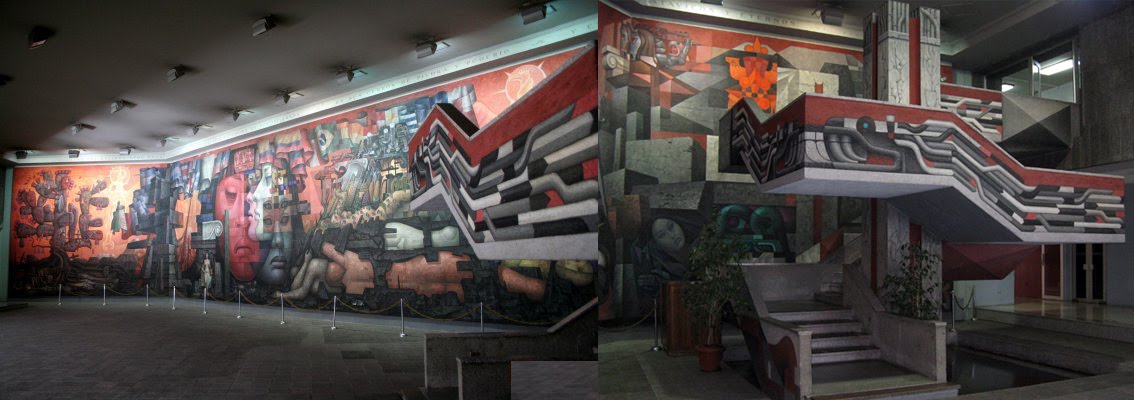
We have most likely heard of the supremacy that exists in the Latin American mural art that tells and represents the history of Latin America. However, what is the true role that these mural art pieces have in Latin America. How is it that the murals unify Latin America in just one culture?. The mural art is a present reality in Latin American culture that transcends borders, people, and dialects. But, why do we only find them on a larger scale more common in Latin American culture and not so much in other cultures? 
"Presencia de América Latina"

If I analyze the Mexican murals by Rivera with those that are found in Chile, I think that we find more than just a representation of identity.  The majority of the Mexican murals were painted after the Mexican revolution during a time when the people were extremely divided by history; a people who oppressed the workers and the farmers that fought to overcome the effects of the war, one being illiteracy.  Therefore, these murals had the intention to teach the story through images for those who did not know how to read.  Its main purpose was so that all would see it and come together again as a society after the division that the Revolution had produced.  In Chile, we find that most of the murals that were painted were done during the dictatorship as a manifestation of their disapproval of Pinochet’s regimen military.  These murals invited the unification of the people in order to defeat oppression. So, in both countries we find that after a period of division, murals begin to appear as instruments in unifying the masses.
Perhaps in Latin American history there have been great divisions among the people and that is why we find so many murals.  These divisions have been so profound that maybe that is where the idea of great murals comes from; murals that play a powerful role as a tool in unifying the people.


Wednesday, October 3, 2012

The orgin of Latin America is not what it seems

“During Mass, Conceicao kept appearing between me and the priest.” (-Joaquim Maria Machado de Assis “Midnight Mass” p. 101).

One of the things that characterize Machado is the ability that the author possesses as a writer to invite his readers to find what lies deeper than what is on the surface of his stories.  This method converts the readers into co-authors of the work. This idea of exploring through his stories is reflected in the same way when we try to find answers to the origin of Latin America.

As in the end of the story “Midnight Mass,” Machado represents the idea that he is viewing the woman Conceicao as an infinite being during the mass when he cannot get her out of his head. This is because he has not been able to read and understand her completely. The author leaves the end of this story open to the reader and invites them to do what he could not, figure her out.

Machado said, “We kill time, but time is what buries us.” The way in which he invites us to kill time is through thinking about the things that we haven’t been able to figure out.  We know that history has buried many things, and we should continue to think and analyze in order to contribute to the future and earn our right to judge the past.  Many are the theories such as Malinche, Iracemas, or Pocahontas, that all result in the pondering and searching for a response for the questions which up until now have not be answered. Even now, time has resolved to bury this lost piece of the puzzle, the answer to the question of where we come from in Latin America.


Machado helps us understand that we cannot understand his books without analyzing them to find the ending that best complements our reality.  In the same way, we will not comprehend the origin of Latin America without thinking and analyzing the past for ourselves.

This reminds me of a video of a selective attention test. It demonstrates how sometimes we have to look at things more than once in order to completely understand the reality of them. In the case of the origin of the Latin American, we perhaps need more Malinches and Iracemas to help us understand the history.
 

Wednesday, September 26, 2012

Mexican way.


"…Velasco has added ...nature and technology in balance…”. Art in Latin America, 107.


José María Velasco, El citlaltépetl, 1879.


We spent time in class discussing the meaning of the train in the paintings of Jose Maria Velasco. I think after I ponder this symbolism in his landscapes, that I come to the conclusion that every work of art does not arise in isolation in time and space, this corresponds to a particular historical moment, marked in turn by different social and political processes. For Velasco, that context was represented by Mexico's independence formation and subsequent consolidation.

The artistic production of José María Velasco is the period of Mexico's history in which liberal ideas were forged, configuring an economic development model that incorporated the country into an industrialization process. 

The word "landscape" (paisaje in spanish) is associated with "country" (país in spanish), which itself derives from "pact", which is the association of the "heathen" who live together or have chosen to live together in the same place. The heathen are those who have no other gods than the gods of the place. A landscape would look like the association of some people around a place and a covenant. Velasco, was extremely jealous of the giving image and representation to the gods of the place that inhabit his lot.


José María Velasco, Bridge at Metlac, 1881.

 Although during the last class it was said that Velasco did not transmit ideals from Mexico through its landscapes, I definitely think He did. Not only is it spread through his works the beauty of nature in the Valley of Mexico with an extraordinary visual ability, but it can also be found in his paintings a representation of modernity in a young Mexico; representation of progress in a country that had just separated from the Spanish yoke. This gives us an idea of the things he possibly felt proud of in his country at that time.

It is through this idea of representation of modernism in Mexico amidst the beauty and wildlife of the environment that I remember the words to the music of the Latin American song by Calle Trece, thinking about that phrase that says ".. soy desarrolo en carne viva…” (I'm development in the flesh).